

Hello! Welcome to Patient-Led Research Collaborative’s (PLRC) Quarterly Newsletter — this publication goes out four times a year to bring you the latest updates on PLRC’s work and critical updates on Long COVID and associated conditions.
This issue covers:
- New PLRC Study on Algorithmic Dependence in Long COVID Phenotypes
- Two New PLRC Opinion Papers: Recommended Outcomes Measures & Patient Review in Research
- Long COVID Treatment Guide Webinar
- New Publications Co-Authored by PLRC Members
If you have been forwarded this email and would like to continue to hear from us:
New PLRC Study Phenotyping Long COVID

PLRC has a new paper out in Oxford Open Immunology on algorithm dependence in Long COVID phenotyping. Phenotyping means to make groups of patients by disease feature — in Long COVID research, the majority of phenotyping papers have been clustering by symptoms. The problem, however, is that while these clusters may sound clinically meaningful, they are often reductive and non-reproducible across different teams (meaning different researchers find different clusters). We investigated this by asking: does applying different clustering algorithms to the same patients yield similar results? The short answer: no.
Leveraging PLRC’s unique dataset of over 6,000 participants and 162 Long COVID symptoms, the team applied three different machine learning algorithms to cluster patients based on their symptom profile. The clusters produced were not the same across the three algorithms, even though each method produced clinically plausible clusters.
Key takeaways:
- Single-method Long COVID phenotyping may produce incomplete or unstable subgroup definitions
- Researchers that are attempting phenotyping by symptom should be cautious about over-interpreting the reliability of their results
- PLRC would like to see more phenotyping by biomarker results; symptoms alone are not sufficient
Bottom line for clinicians and researchers: symptom clusters are useful exploratory and communication tools, but not fixed diagnostic types. Don’t treat single-method clusters as biologically discrete subtypes or use them to define study or clinical trial eligibility without checking robustness.
Two New PLRC Opinion Papers:
Recommended Long COVID Outcome Measures | Case For Routine Patient Review
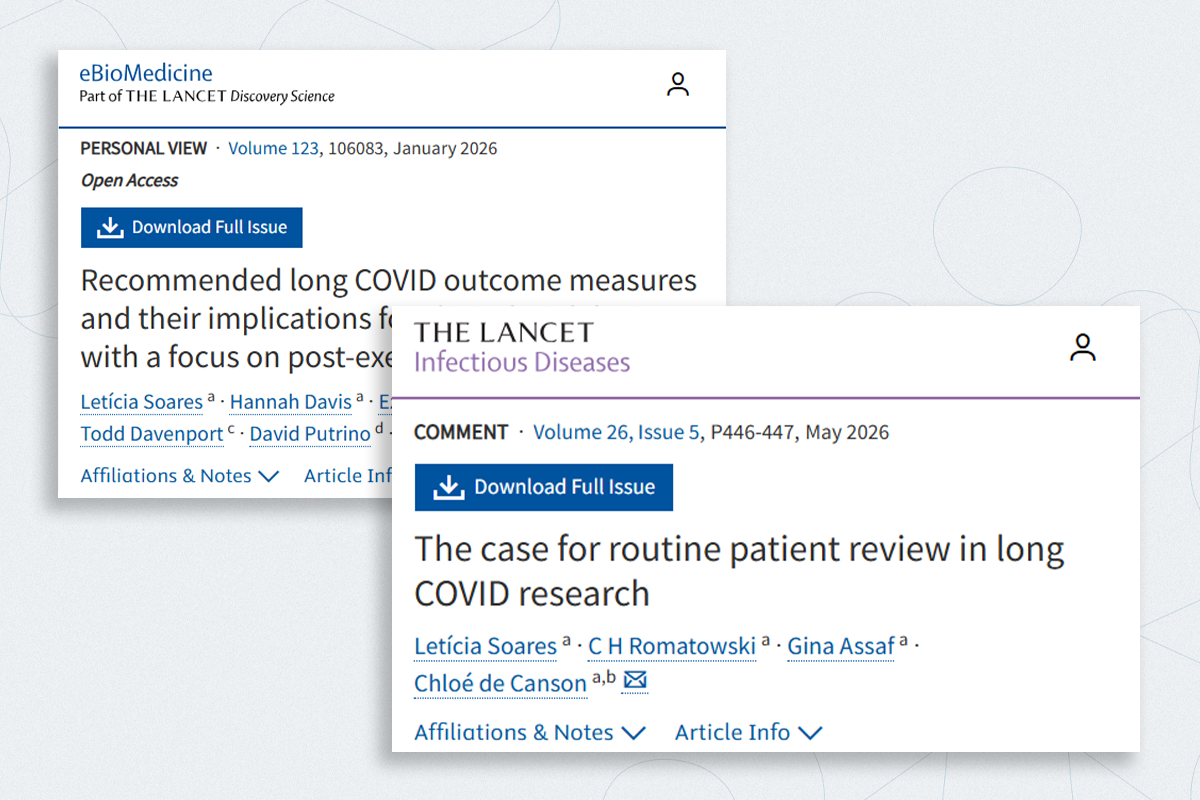
PLRC has published two new opinion papers that advance Long COVID research contributing to study design and interpretation by integrating lived experience expertise and data. Explore the key take-aways from these two papers below:
1. Recommended Long COVID outcome measures and their implications for clinical trial design, with a focus on post-exertional malaise—
The paper summarizes the current challenges and considerations of outcome selection in Long COVID trials, along with recommendations for current trial design and future endpoint validation, with a focus on post-exertional malaise (PEM). PLRC partnered with leading clinicians and trialists in the field to present a list of outcomes that may be considered for Long COVID clinical trials. Crucially, the field of Long COVID clinical trials urgently needs funding and research effort investment to develop and validate outcomes concomitantly with clinical trial research. Read the full paper in eBioMedicine.
2. The case for routine patient review in Long COVID research––
People with Long COVID have played a crucial role in the field’s development, establishing Long COVID as a disease entity in the scientific literature, yet they’re still frequently excluded from research or included in ways that fail to integrate their expertise. Structural incentives are therefore needed to ensure institutional researchers engage patient expertise meaningfully throughout the research process. We believe that routine patient review of all manuscripts on Long COVID, including but not limited to clinical trial protocols and results, pathophysiological research, and opinion pieces, can play this incentivizing role. Read the full comment in The Lancet Infectious Diseases.
Long COVID Treatment Guide Webinar
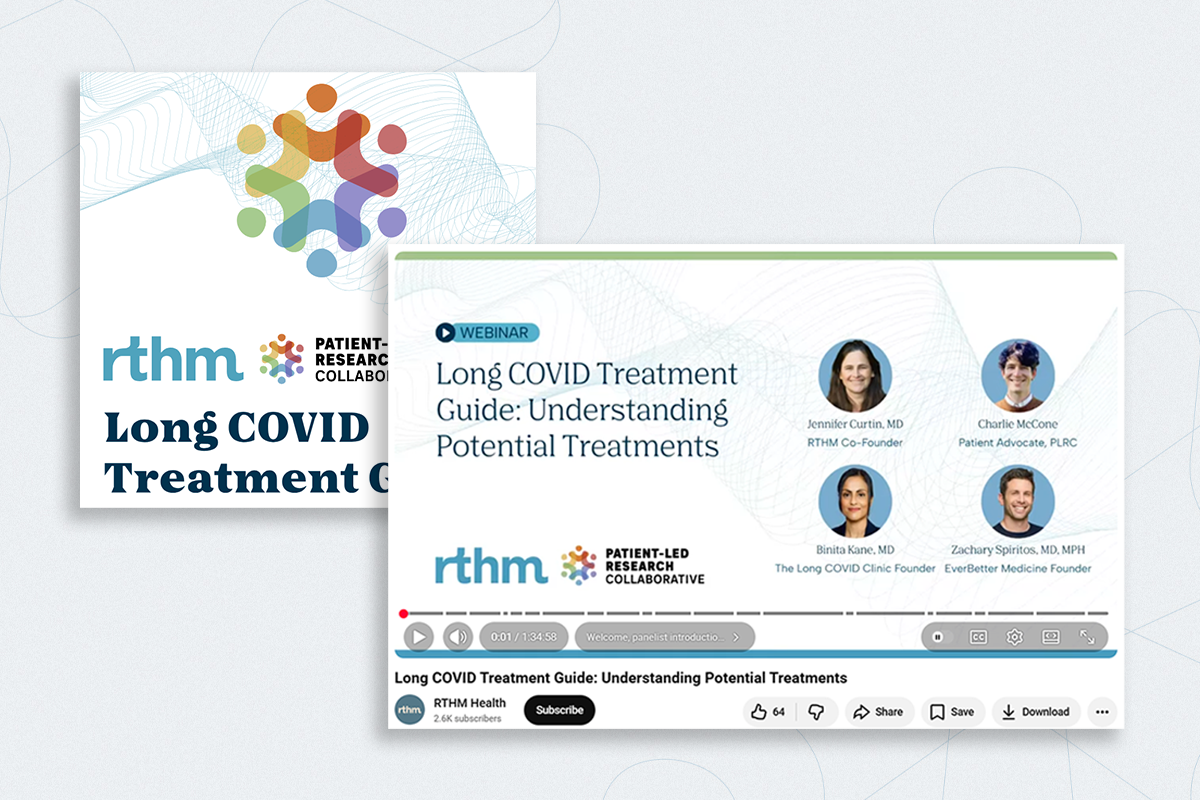
Earlier this year PLRC and RTHM Clinic released the Long COVID Treatment Guide designed to help patients and clinicians have more informed, meaningful conversations about treatment options that may become part of a personalized care plan. It includes 24 prescription medications, along with select supplements, over-the-counter medications, procedures, and lifestyle strategies.
PLRC and RTHM recently hosted a webinar discussing how patients and clinicians can best use the Treatment Guide, the inspiration behind it, and a variety of questions in regards to the treatment landscape for Long COVID and associated conditions.
Panelists included:
Zachary Spiritos, MD, MPH: EverBetter Medicine Founder
Jennifer Curtin, MD: RTHM Co-Founder
Charlie McCone: PLRC Co-Lead
Binita Kane, MD: Long COVID Clinic Founder
New Publications Co-Authored by PLRC Members
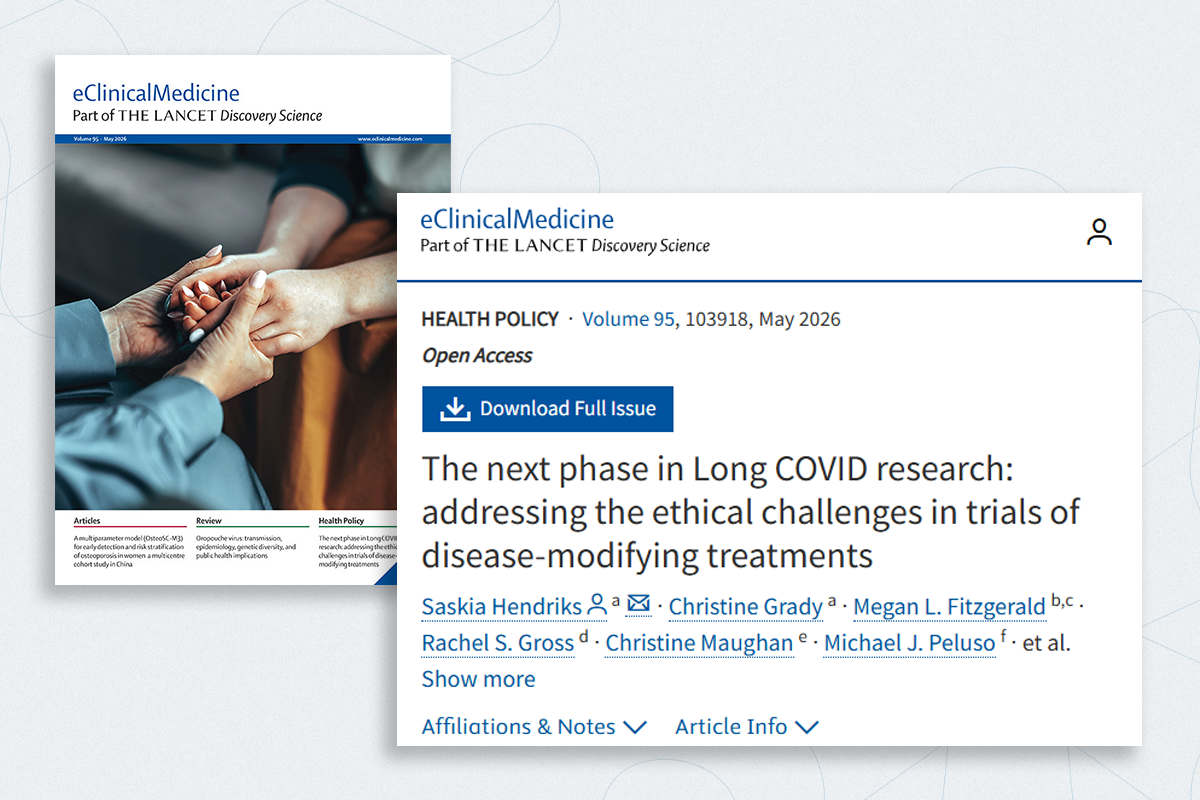
PLRC patient-researchers have co-authored two new papers resulting from their collaborative work with academic researchers in multiple countries. Explore the key findings from these two papers below:
1. The next phase in Long COVID research: addressing the ethical challenges in trials of disease-modifying treatments—
The scientific uncertainties around Long COVID have been cited as a reason to delay treatment trials until the disease is better understood. In this paper, a group of bioethicists, clinician-scientists and people with lived experience with Long COVID argue that it is ethically imperative to conduct trials of disease-modifying treatments for Long COVID now. Furthermore, they argue that although conducting such trials can pose ethical challenges, these challenges can be overcome through careful research priority-setting, rigorous trial design, fair participant selection, and ensuring that the risk-benefit profile is favorable. Read the full paper in eClinicalMedicine.
2. Sustained Reduction in Cardiopulmonary Fitness in Long COVID: A Report from the RECOVER-adult Cohort Study––
Using wearable devices data and quarterly surveys, the study looked at heart and lung health in 1,475 people at about 21 months after COVID infection and found measurable differences in health: lower heart rate variability, elevated heart rates, lower average step counts, reduced active minutes.
“...reduced cardiopulmonary fitness and decreased physical activity reflects a combination of limited exercise capacity and intentional pacing to reduce the risk of post-exertional malaise, rather than a lack of motivation or interest in exercise.” Read the full paper in JACC
Read, Listen, Watch & More
- Read:The Sick Times, “RECOVER’s first round of clinical trials are failing. Will the next phase be better?” featuring PLRC co-lead Hannah Davis
- Watch: Long Covid Web, “Patient Perspectives on Long COVID in Primary Care and Clinical Trials” ft. PLRC co-lead Dr. Letícia Soares
- Listen: POTScast, “The Long COVID Treatment Guide” ft. PLRC co-lead Charlie McCone
- Read: Los Angeles Times, “What COVID is teaching doctors about the relationship between viruses and cancer”
- Read: Health Rising, “Hitting the Target? ME/CFS and long COVID T-Cell Researchers on Uncovering the Precise Drivers of the Illnesses”
- Read: The Washington Post, “Your Birth Order Affects Your Future, but not for the Reason You Think”
- Read: The Sick Times, “Alice Wong showed us Disability Justice makes our advocacy stronger” op-ed by PLRC co-lead Charlie McCone
- Watch: Yale Accessibility Symposium, “When Rest is Resistance” presentation by PLRC member V. Ashley
- Read:The Sick Times, “Breaking the vicious cycle: How two German scientists seek to solve ME”
- Read: New York Times, “Buildings May Soon Have ‘Immune Systems’ That Fight Airborne Disease”
- Read: Caregiver Wisdom, “The Best ME/CFS & Long COVID Treatment Guides in the US: A Round-Up for Patients, Caregivers, & Clinicians”
- Watch: YouTube, “Røysumtunet – Avdeling for ME”
- Listen: Still Here, “The Way Disabled People Love Each Other”: In conversation with Leah Lakshmi Piepzna-Samarsinha
- Read: Men’s Health, “Millions of People Live With Long COVID. This Researcher Is on a Mission to Find a Cure.”
- Volunteer: We welcome patients with Long Covid and other IACCs and caregivers to join PLRC! Please fill out the volunteer form to submit.
Your donations support our work to conduct research and advocate for policies that enable patients to survive and thrive.
In solidarity,
Team PLRC
PS. Please reach out to team@patientledresearch.com to collaborate with our team or sponsor future Journals.